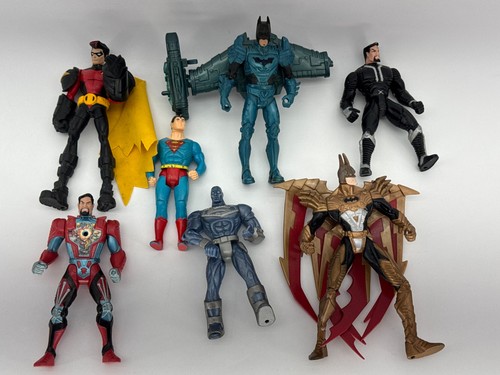
The short version
- DC Multiverse is not one line. Mattel used the name in the mid-2010s and McFarlane has used it since 2020, so the phrase in a listing title tells you almost nothing until you know which.
- Scale is the practical consequence of all this history: the older six-inch figures and the current seven-inch ones look wrong standing together, which is the thing most buyers wish someone had told them first.
- Loose DC figures frequently arrive missing a build-a-figure part, a display base or an art card, and each of those is a real deduction rather than a detail.
If you have ever tried to work out what you are looking at from a DC figure listing, you have run into the central problem: DC does not make its own toys, it licenses them, and it has changed partners often enough that four different companies have made a seven-inch Batman in living memory. Their figures do not match each other, and in several cases they do not even use consistent naming.
Sorting this out is worth twenty minutes because it changes what you buy. Below is who made what, what each maker was actually trying to do, and the one question that matters more than any of it.
The name collision that causes most of the confusion
Start here, because it explains why searching is so unrewarding. DC Multiverse has been the name of two entirely separate lines from two entirely separate manufacturers. Mattel used it in the middle of the 2010s. McFarlane Toys has used it since taking over the licence in 2020. They are different sizes, different styles and different price brackets.
So a listing title containing those two words is not a description, it is a starting point. What identifies the figure is the packaging branding, the scale, and the presence or absence of the things each maker included — which is what the rest of this is about.
DC Direct and DC Collectibles: the publisher's own shelf
DC Direct began in the late 1990s as the publisher's in-house collectibles operation, selling primarily through comic shops rather than toy aisles. It was rebranded DC Collectibles in the 2010s, and the DC Direct name has since returned.
The intent was never the toy aisle. These are collector pieces first: heavily sculpted, often built around a specific artist's rendition of a character, with lines named for and modelled on the work of individual comic artists. The trade-off is movement. Articulation is typically limited compared with a mainstream figure, sometimes deliberately so, because the sculpt is the product.
The consequence for a buyer is that scale is inconsistent by design. Different lines were built to look right on their own terms rather than to stand in a single unified army, so two figures from different DC Direct lines may not agree with each other, let alone with anything from another maker. If you are buying to display a single artist's roster together, that is a feature. If you are building one shelf of everybody, it is a problem.
Mattel's run: Classics, Multiverse, and the Collect and Connect habit
Mattel held the mainstream DC figure licence for a long stretch before McFarlane, and its collector lines settled around six inches. The characteristic Mattel move was Collect and Connect: each figure in a series carried one component of a much larger figure, so buying the whole series got you a bonus character assembled from the parts.
That mechanic is the single biggest thing to check when buying Mattel-era figures secondhand, because it created a permanent secondary problem. Series get parted out. A seller who wants the large figure buys the series, assembles it, and sells the individual figures on without their component. Those figures are perfectly good and often cheap, but they are not complete, and a listing rarely volunteers the distinction.
So the question to ask about any six-inch Mattel DC figure is simply: does it still have its Collect and Connect part? If the answer is no, that is fine, provided the price reflects it and you were told.
McFarlane, 2020 onward
McFarlane Toys took the DC licence in 2020 and moved the mainstream collector figure to roughly seven inches. The house style is dense sculpting and high paint detail, and the packaging is part of the proposition: releases typically include a display base and a printed art card alongside the figure.
McFarlane also labels its releases in tiers, which is genuinely useful once you know the vocabulary:
- Gold Label marks special and retailer-tied releases, sitting outside the standard numbered run.
- Platinum Edition marks rare variant figures seeded into shipments — the same idea as a chase, and the same warning applies: once the packaging is gone, the proof is gone with it.
- DC Retro is a separate carded line styled deliberately after the toy packaging of the 1960s and 1970s, including figures based on the 1966 television series. These are meant to be displayed carded, so the card condition is a large part of what you are paying for.
For a loose McFarlane figure, the base and the art card are the two things most likely to be missing, and both are worth asking about before you commit.
The rest of the peg
Plenty of DC product never came from any of the four above, and some of it is excellent value precisely because it is harder to categorise.

- Movie tie-in lines. Other manufacturers have produced DC film ranges alongside the collector lines, some of them carrying their own build-a-figure components. They tend to be built for play rather than display, which usually means lower paint detail and a much lower price.
- Retro-styled vinyl and 3.75-inch figures. Funko's ReAction line reproduces the look of late-1970s carded toys, right down to five points of articulation, and covers DC characters that never got a figure at the time. They are cheap, they display well as a group, and carded examples are common.
- Die-cast. Batman vehicles are a collecting lane of their own, largely separate from figures, and premium die-cast releases with rubber tyres and metal bodies sit well above the basic ranges. That stock lives with the rest of our die-cast.
- Statues, busts and dolls. Sealed adult-collector dolls and cold-cast statues turn up regularly in estate lots and are usually valued on the box and the certificate as much as the piece.
Scale: the question that decides everything else
Everything above resolves into one practical fact. Six-inch and seven-inch figures do not stand together convincingly. The difference sounds trivial written down and looks obvious on a shelf, because the human eye is very good at spotting a character who is the wrong size relative to a character it already knows.

Before buying, decide which shelf you are building. If you already own a Mattel-era collection, adding current McFarlane figures will mean two displays rather than one. There is nothing wrong with two displays; there is something wrong with discovering you have them after the money is spent.
Buying loose, carded, or as a lot
Three shapes of purchase, three different things to watch.

- Loose. Ask about accessories, build-a-figure parts, bases and cards. Ask about joint tightness, since older figures loosen at the hips and stiffen at the elbows, and a figure that will not stand is a display problem.
- Carded. The card is most of the value. Look for corner wear, creasing across the printed area, yellowing of the bubble and any sign the bubble has lifted at an edge.
- Lots. Parts and repair lots are genuinely useful if that is what you want, and a waste of money if you were expecting complete figures. When a listing says parts, believe it. Read the photographs rather than the title.
We photograph every piece as it actually is, missing parts included, and we describe condition rather than grade it — we are a resale showroom and not a grading service, and pretending otherwise would be the easiest lie in this business to tell. Our DC stock runs across figures, comics and die-cast at once, so it is worth browsing sideways. If the same identification problem in a franchise with a longer continuous toy history interests you, the Star Wars lines guide covers that, and the exclusives guide explains the labelled tiers that turn up across all of these makers.
Wrestling figures are built on the same idea of tiered lines at different price points, so if the DC tiers made sense to you the reasoning maps straight across to WWE Elite, Basic and Ultimate Edition.