The short version
- Single stitch means one line of stitching holding a hem; double-needle means two parallel rows. Production moved to two rows through the late 1980s and early 1990s.
- A tag can be cut out, swapped or worn away. A hem cannot be changed without losing length and leaving needle holes, which is why the seam is better evidence than the label.
- Single stitch is not proof of age on its own, because modern reproduction blanks use it deliberately and some always have.
Ask someone how to tell whether a T-shirt is old and they will reach for the neck tag. It is the obvious move and it is the weakest one available, because the tag is the part of a shirt most easily removed, replaced, faded into illegibility or printed on in ink that washes off.
The hem is different. It is structural. Changing it means cutting fabric, which shortens the garment and leaves evidence in the cloth. That is why people who handle a lot of shirts look at the stitching first and the label second, and it is a habit worth borrowing. This is a hands-on guide: put the shirt in front of you and work through it.
Turn it inside out first
Everything here is easier from the inside, in daylight or under a bright lamp. Turn the shirt fully inside out and lay it flat rather than holding it up, because tension distorts stitching and makes two close rows look like one.
What you are counting is rows of stitching along a folded hem. Single stitch means one line of thread securing that fold. Double-needle means two parallel rows, sewn simultaneously, sitting a few millimetres apart. From the outside they can be hard to distinguish on dark fabric. From the inside, where the looper thread runs, the difference is unmistakable.
Count on each hem separately. They are not always the same, and that is information rather than a complication.
Seam one: the sleeve hem
Start at the sleeve opening, because this is the seam the convention is really about and the one most consistently reported.

A single row here points earlier. The industry moved towards double-needle hemming on sleeves and bodies through the late 1980s and into the early and middle 1990s, driven by faster machinery and a sturdier result. That transition is the basis of the whole heuristic.
Notice what that sentence does not say. It does not name a year, because there was not one. Different manufacturers converted at different times, different factories within one manufacturer converted at different times, and the change ran across roughly a decade rather than happening on a date. Anyone giving you a single cut-off year is tidying up history. What you can safely take from a single-stitched sleeve is a probability that the shirt sits before the middle of the 1990s, which is a genuinely useful thing to know and not the same as a date.
Seam two: the bottom hem
Now the bottom of the body. Usually it matches the sleeve, and when it does you have two independent observations agreeing, which is worth more than one observation twice.

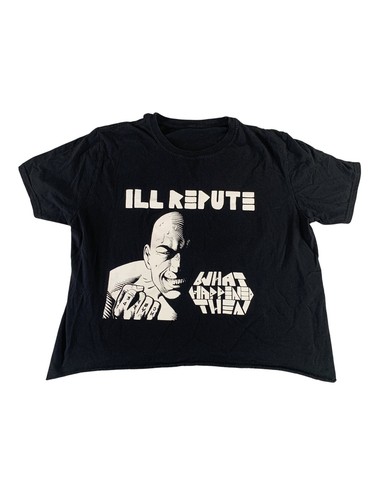
When it disagrees, slow down. A single-stitched sleeve with a double-needle bottom hem is possible from a transitional production run, and it is also exactly what you get when somebody has shortened a shirt. Cropping is common, both as an alteration people made for themselves and as a way of removing damage from a hem.
The tells for a shortened shirt are worth learning because they apply well beyond this test. Look at the proportion of the body to the sleeves, which will read short. Look for a line of empty needle holes in the fabric above the current hem, where the original stitching was. Compare the thread colour and sheen against the sleeve stitching, since a home alteration rarely matches. And feel the hem depth, which on a factory hem is even the whole way round.
Seam three: the sides, or the absence of them
Run a finger down the side of the body from armpit to hem. Either there is a seam or there is not.

A shirt with no side seams was knitted as a continuous tube, and tubular construction was standard on a great deal of older production. Side-seamed bodies became more common as fitted cuts took over, because a tube cannot be shaped and a seamed body can.
Treat this as supporting evidence and nothing stronger. Tubular construction is cheap, so it never went away — plenty of inexpensive modern blanks are tubular, and some current brands use it deliberately for the boxy fit it produces. Tubular plus single stitch plus a period neck tag is a coherent picture. Tubular alone is close to meaningless.
Why a hem beats a tag
It is worth being explicit about why this whole exercise is worth the trouble, because it generalises.
A neck tag is an applied component. It can be cut out by an owner who found it scratchy, which was extremely common. It can be replaced. On modern garments it is frequently not a tag at all but a heat transfer, which disappears entirely after enough washes and leaves nothing behind. And because tags are what buyers look at, they are what anyone hoping to mislead concentrates on.
A hem cannot be edited without consequence. Adding a row of stitching to fake a double-needle hem leaves you sewing over an existing hem, which looks exactly like what it is. Removing a row and re-hemming shortens the garment and perforates the fabric where the old stitches were. There is no cheap way to make a hem lie, and that is the entire argument.
This is the same reasoning that makes construction outrank printing on denim, where the concealed rivets and the seam finish carry more weight than anything on a label — the jeans version of the argument works through it in detail.
The four ways this test lies to you
- Reproduction blanks. There is an active market in modern blanks made deliberately to older specifications, single-stitched and tubular on purpose, sold to people printing new graphics that are meant to feel old. These are honest products being used honestly most of the time. They also defeat this test completely.
- Production outside the United States. The transition described here is a story about a particular industry in a particular place. Conventions elsewhere ran on their own timetables, so a single-stitched hem on a garment made elsewhere carries much less date information.
- Deliberate style choices. Some brands single-stitch because they like the way it looks and drapes. That has nothing to do with age and everything to do with taste.
- Alterations. Covered above, and the most common of the four in practice. A shortened shirt can convert either way and will mislead you unless you look for the needle holes.
Notice that all four failures push in the same direction: they make a modern shirt look older. There is no common failure mode that makes an old shirt look new. That asymmetry is useful — it means a double-needle hem is fairly strong evidence against age, while a single-stitched hem is only moderate evidence for it.
What to combine it with
The hem is one input. Corroborate it with the neck tag brand where one survives, the fibre content, the country of manufacture, the style of the collar ribbing and how much recovery it has left, and the printing method used for any graphic.
On a graphic shirt the print is a whole separate line of evidence, and on a music shirt it is usually the decisive one — the questions worth asking about the print itself are set out separately, because they have almost nothing to do with construction.
The general principle: two weak signals that agree are worth more than one strong signal alone, and any signal that contradicts the others deserves an explanation before you ignore it.
Checking this from a listing photograph
Most of the time you are looking at a screen rather than a garment. The requests worth making are specific ones, because a vague question gets a vague photograph.
- The inside of a sleeve hem, laid flat, in daylight, close enough to count rows of thread.
- The inside of the bottom hem, framed so that the fabric above it is visible too — that is where old needle holes would show.
- The neck tag, or a clear shot of where it used to be.
- The garment laid flat with a tape across the chest and from shoulder to hem.
A seller who cannot photograph a hem has usually not looked at it, which is worth knowing on its own.
A note on what we sell
We are a resale showroom. Everything here is pre-owned, and where a listing says new or still tagged, that is a description of the garment's condition rather than a claim about its history.
We do not grade, authenticate or attribute a date on your behalf, and this guide exists partly so that you do not need us to. What we do is photograph the specific garment, measure it flat, and describe what is actually there. Where a hem or a tag is interesting we try to show it, and if a listing does not show what you need, ask — that request costs us nothing and saves a return. Shirts live in women's clothing and men's clothing, with older pieces in vintage and smaller sizes in kids and baby.