The short version
- The 1990s produced an enormous quantity of 1:64 NASCAR die-cast, and that supply is still the single biggest fact about the market — most of it is common, and common is not a criticism.
- Value concentrates in four places: who drove it, whether the paint scheme ran once or all season, which tier of the manufacturer's range it came from, and whether the box survived.
- Transporters and haulers behave like a separate small market with its own logic, because they were bought by adults as display pieces rather than opened by children.
NASCAR die-cast is one of the few collecting categories where the honest answer to “what is this worth?” usually starts with a downward adjustment. That is not a reason to avoid it. It is the reason it is one of the cheapest ways into a display shelf that actually looks like something, and it is why the pieces that do carry value carry it for reasons you can identify yourself.
What follows is the shape of the market rather than a price list. We do not publish valuations, and any guide that gives you a number for a car it has not seen is guessing.
Start with the supply, because supply is the story
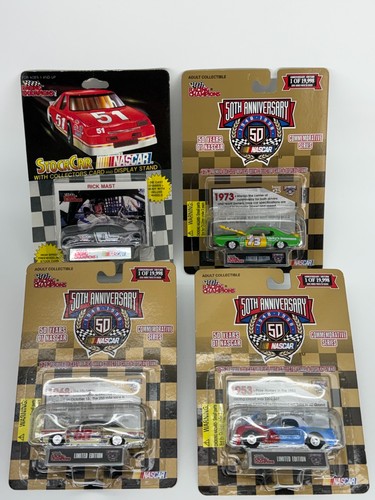
Through the 1990s, NASCAR die-cast was mass-market retail. Racing Champions in particular put an enormous volume of 1:64 cars through grocery stores, drug stores and hobby aisles, year after year, across dozens of drivers and sponsors. A great many of those cars were bought by adults, never opened, and stored carefully — which means that thirty years later the survival rate in good condition is high as well.

High production plus high survival is the definition of a common item. So when you see “Limited Edition” printed on a 1990s box, read it as marketing language rather than as information: it frequently meant a large run, and it almost never meant a number small enough to matter. The phrase does not, on its own, tell you anything.
The practical consequence is genuinely good news. It means the entry price for a shelf full of period-correct cars is low, and it means you should buy on the thing you actually like — a driver you watched, a sponsor livery you remember — rather than on a hope about appreciation. Everything below is about the exceptions.
The driver is the largest single variable
Demand in this category is personal in a way it is not in, say, Hot Wheels. People collect the driver they followed. That concentrates demand hard onto a relatively small number of names, and it keeps it there for decades after the career ends.
The names that reliably pull are the ones with the largest and longest fanbases — Dale Earnhardt, Richard Petty, Jeff Gordon, Dale Earnhardt Jr. among them. A car carrying one of those numbers will find a buyer at a level a talented but less-followed driver's car simply will not, even when the two were produced in the same quantity by the same maker in the same year.
It also means driver demand and rarity can point in opposite directions. A genuinely scarce car for a driver nobody collects is a slow sell. An extremely common car for a driver everybody collects is not.
Paint schemes: how many races did it run?
This is the check most people miss, and it is the most useful one in the whole guide.

A primary scheme — the livery a car wore for most of a season — was modeled by everyone, in every scale, repeatedly. A one-off scheme was not. Special paint appeared for a single race or a short stretch: a movie tie-in, a charity or commemorative livery, an anniversary for the sponsor, an all-star race special, a throwback. Those got a single production run at most, aimed at people who were already paying attention.
So when you are looking at two cars for the same driver from the same year, the question is not which looks better. It is which one ran once. A quick sanity check: if the livery looks unlike anything else that team ran that season, that is usually the interesting one.
Two adjacent categories behave the same way for the same reason. Cars commemorating a specific win or a championship were produced after the fact, for a known audience, and are usually marked as such on the box. Memorial and final-season pieces sit in the same bracket.
Manufacturer and tier, which are not the same question
Knowing the maker tells you roughly which market a piece was built for.
- Racing Champions was the volume player, especially in 1:64. Retail distribution, broad driver coverage, boxed and blistered, and produced in quantity. This is the bulk of what most collections turn out to contain, and it is where the affordable fun is.
- Action Performance and its Action Racing Collectables line served the serious end, mainly in 1:24, with heavier castings and more opening parts. Its club program, the Racing Collectables Club of America, sold to members in deliberately smaller numbers — club and elite pieces from that side of the business are where genuine scarcity in this category tends to live.
- Lionel Racing carried the licensed program later, with its own tiered range running from mass-market up to limited elite pieces.
Within any of them, the tier matters more than the badge. The same manufacturer's ordinary retail car and its club-only elite car are different objects with different production realities, and the box almost always says which is which. Read the box.
Transporters and haulers are their own small market
The 1:64 team transporters — the tractor units and trailers in full sponsor livery, often packaged with a matching car — behave differently from the cars, and it is worth knowing why.
They were never really children's toys. They were bought by adults, as display pieces, and put on a shelf. So the condition distribution is unusual: proportionally more of them survive complete and boxed than survive played-with. That flattens the premium you would normally pay for a mint example, and it shifts the value onto the specifics of the livery instead — which sponsor, which season, which team.
They also collect well as a set, because a rack of period sponsor liveries reads as a display in a way that a rack of similar-looking stock cars does not. If you have never looked at them, our racing and NASCAR shelf runs deep on 1990s transporters and hauler lots specifically, and they are usually the most visually rewarding thing per dollar in the category.
The box is part of the object
Because so much of this category was bought to display rather than to play with, packaging carries more of the price here than it does in most toy categories. A 1:24 car without its box is a materially different sale from the same car with it, and the difference is larger than newcomers expect.
The things that matter, roughly in order: whether the box is present at all, whether the plastic display window is clear rather than yellowed or crazed, whether the inserts and any certificate or hologram are still inside, and whether the box has been crushed at a corner. For blistered 1:64 cars the same logic applies to the card and bubble, which we go through properly in reading blister card condition.
Storage causes most of the damage that we see arriving here, and almost all of it is avoidable: attic heat deforms plastic windows, sunlight fades printed board, and damp warps card. None of that touches the metal car inside, which is why so many boxed cars are in worse condition than the thing they contain.
How to read a lot listing without getting caught out
A great deal of this category sells in multiples, ours included, and lots are where the value is easiest to misjudge in either direction. Four habits help.

- Count what is photographed, not what is described. The photograph is the contract. If a piece is named in the title but not visible in a picture, ask before you buy rather than after.
- Look for the outlier. Lots are usually assembled by theme or by shelf, not by value, so the interesting piece is frequently sitting in the middle of a group of ordinary ones with nothing drawing attention to it.
- Check whether the boxes are in the photo. A lot of loose cars and a lot of boxed cars are two different products even when the cars are identical.
- Read the scale on each box, not on the listing title. Mixed-scale lots are common, and a 1:24 and a 1:64 of the same car look identical in a top-down photograph. If you are unsure what the numbers mean, the scale guide covers it.
Where we sit in this
We are a resale showroom. We photograph the actual pieces, describe the condition we can see including the flaws, and let you make the call — we do not grade, we do not authenticate, and we do not publish valuations. Everything is pre-owned, including anything described as sealed or new in box; that is a statement about the object's condition, not about its history.
If you have a collection sitting in a closet and this guide has told you something about it, we buy and take consignment as well as sell. But the main invitation is the simpler one: the racing shelf and the wider die-cast department are open, and the cheapest way to enjoy this category has always been to buy the livery you actually remember.